
Search “sites for backlinks” and you get lists: 500 sites, 1,000 sites, “high DA” sites, “instant approval” sites. Almost every one of them is a list of places that will publish anything – which is precisely why the links are worth nothing. What you actually need is a way to sort candidate sites by two things: who controls the link, and how long it lasts.
This is the framework I use to decide where the next ten links come from, in the order I’d spend the time.
Four kinds of site, four different jobs
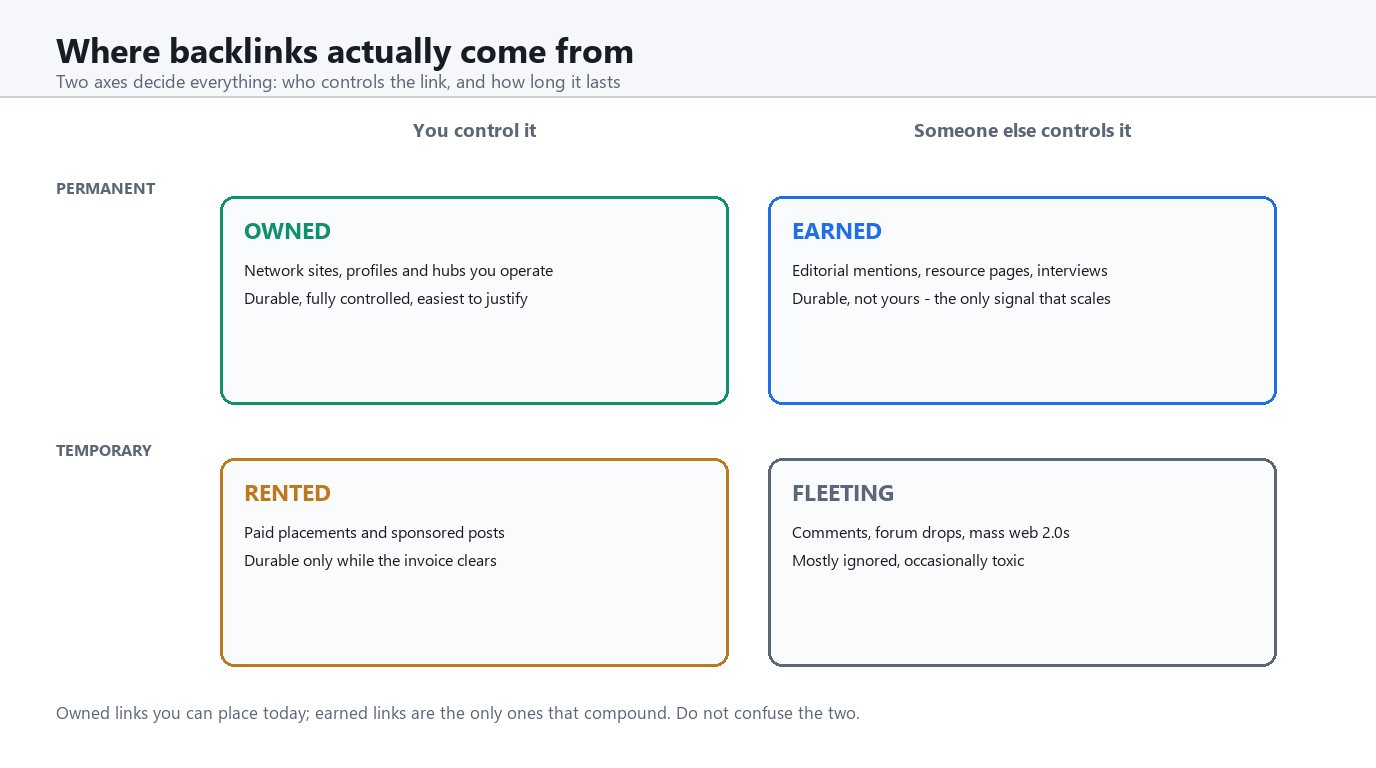
Every place you can get a link sits in one of four quadrants. They are not interchangeable, and treating them as one budget is the mistake that produces a profile of 900 links and zero movement.
What those lists get wrong
Three specific failures, all common:
- They optimise for approval, not for value. A site that accepts every submission has no editorial filter, so Google treats its outbound links as noise.
- They mix link types without saying so. A “DA 60” profile link and a DA 60 editorial mention are not the same asset, even from the same domain.
- They ignore the destination. Twenty links pointed at your homepage do far less than twenty spread across the pages that need to rank.
Owned: the links you can place today
Owned links come from properties you operate: a network of niche sites, author profiles on platforms you actually use, a documentation or tools page on a property you control. They are durable and fully controlled, which makes them the only category you can deploy on a schedule without negotiating.
Two rules keep them useful. First, relevance: a link from a property in an unrelated niche is a footprint, not an asset. Second, restraint: ten contextual links from varied properties with varied anchors look organic; two hundred identical footer links look like exactly what they are.
Earned: the only category that compounds
Earned links are the ones somebody else decided to publish because your page was worth citing: resource pages in your niche, roundups, interviews, tool comparisons, expert quotes. You cannot buy them at scale, and that is the point – they are the only signal that keeps working after you stop paying.
The cheapest earned link in this niche is a genuinely useful asset. In practice that means the pages competitors will not write: a verified-rate table, a settings file people can clone, a comparison with real numbers behind it. If the page cannot be cited in one sentence, it will not be linked.
Rented: paid placements, and when they’re defensible
Paid links are not a strategy, they are a rental. They work while the invoice clears and vanish when it stops – and Google asks that they be marked rel="sponsored", which removes most of the ranking value you were buying. If you pay for placement, pay for traffic and relevance, not for the link.
Fleeting: comments, forum drops, mass properties
Comment links and forum signatures do one thing well: they create crawl paths. A link from an active forum thread can get a new URL discovered within hours. It will not move rankings. Treat these as indexing infrastructure – the same job tier 3 does in a tiered link building campaign – not as authority.
Qualify a candidate site in 60 seconds
- Indexed? Search the domain. If the site itself is not indexed, the link is invisible.
- Relevant? Would a reader of that page plausibly click through to your article? If not, skip it.
- Outbound density? Open the page. Forty outbound links in a list is a directory, not a citation.
- Live link? Check the raw HTML for
rel="nofollow"and confirm the anchor text is what you agreed. - Fresh? A page last updated in 2019 is unlikely to be crawled again soon.
That checklist is the same one that governs an audit, which is why checking the links you already have should come before hunting for new ones.
Where to find candidates without buying a list
You can build a better candidate list in an afternoon than most paid lists contain, because you are looking for relevance rather than volume:
- Who cites the pages you are trying to beat? Pull referring domains for the top three results on your target query and look for sites that cite two of them. That is a real editorial preference, not a directory.
- Who cites the tools you use? Resource pages and tool roundups in your niche link out constantly and are usually maintained by one person you can email.
- Who already publishes the same topic badly? A page ranking for your keyword with an outdated answer is a natural place for a better citation – and a genuinely useful email to send.
Read Google’s spam policies on link spam before you start, because most of the tactics sold as “link building” are named there in plain language: bought links, exchanged links, automated links, and links from sites built only to host them. It is a short document and it settles most arguments about whether a tactic is safe.
One more thing worth internalising: a link only counts if the page can be crawled and the link is crawlable markup. Google’s guide to crawlable links covers the technical cases – JavaScript-only links, links behind forms, links with the wrong rel attribute – and those are the ones that quietly waste a placement you already paid for.
A worked plan: twelve links in 90 days
For a site in this position – 77 referring domains, a high spam score, no indexed articles – the useful target is not volume. Twelve relevant links over three months, split across the four quadrants, beats a hundred directory submissions:
- Four owned: contextual links from properties in the same niche, each to a different article.
- Four earned: resource pages and roundups where your comparison or template is genuinely the best answer.
- Two rented, only if the placement brings referral traffic you can measure.
- Two fleeting, aimed at whichever new URL is not being crawled.
Point them at the pages that must rank, not at the homepage. A pillar page with four inbound links and twenty internal links outperforms a homepage with twenty and none – which is exactly the structure the tiered link building framework is built around.
FAQ
How many backlinks do I need to rank?
There is no number – it depends on the query. For low-difficulty terms, four to eight relevant referring domains pointed at the right page are usually enough to compete. Compare against the pages currently ranking for your term rather than against an industry average.
Are free backlink sites worth using?
As indexing help, sometimes. As authority, no. A free directory that publishes every submission has no editorial signal to pass, and a large volume of them is more likely to look manipulative than helpful.
Should I buy backlinks?
You can buy placement, but you cannot buy an editorial endorsement – Google requires paid links to be marked sponsored, which removes the ranking benefit. If you spend money on links, spend it on relevance and referral traffic you can measure.
What is a good anchor text mix?
Mostly branded and URL anchors, with a minority of partial-match and generic phrases. Exact-match keyword anchors should be rare – on tier 2 they actively devalue the property they point at.
What to read next
If you are deciding where the next links go, read what dofollow actually means first, then the tool stack for the crawlers and lists worth paying for.