
“Dofollow” is not an attribute. There is no rel="dofollow" in HTML – a followed link is simply a link with no rel value telling search engines to discount it. That small misunderstanding sits behind most of the nonsense sold as “dofollow backlink packages”, so it is worth thirty seconds of clarity before anything else.
Here is what the attributes actually do, how to check one in the wild, and which sources are worth the effort in 2026.
The four rel values you will meet
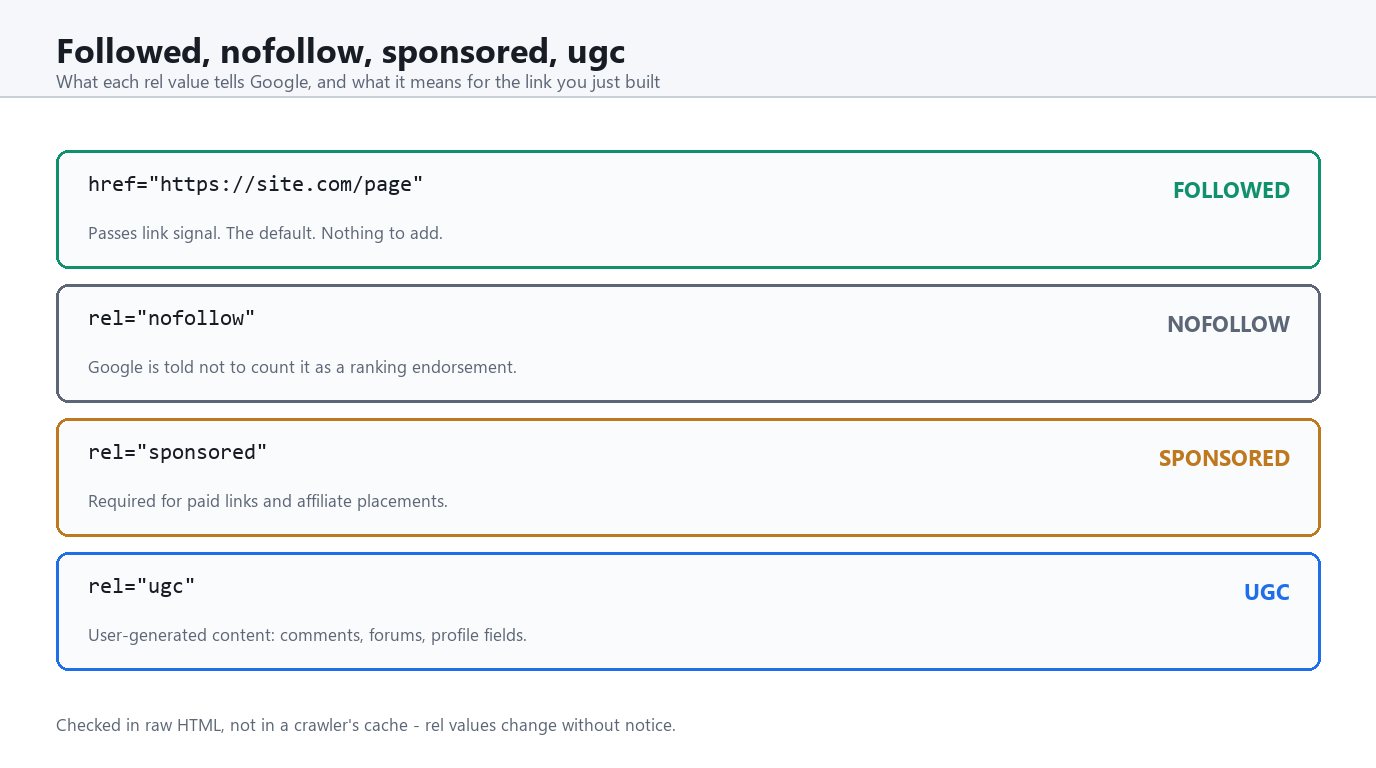
A link with no rel attribute passes link signal by default. Adding rel="nofollow" tells Google not to treat the link as an endorsement. rel="sponsored" is the correct markup for paid and affiliate links, and rel="ugc" for user-generated content. Google’s documentation on qualifying outbound links is the reference, and it has been explicit since 2019 that nofollow is a hint rather than a directive.
Why nofollow is not worthless
Three reasons, in order of how much they matter:
- Discovery. A nofollowed link is still followed by the crawler. It creates a path to a URL that otherwise would not be found.
- Traffic. A nofollowed link from a page people actually read sends visitors, and visitors are the thing affiliate revenue is made of.
- Trust. Being cited by a source that nofollows everything is still a citation. The entity association exists whether or not the link passes PageRank.
What a nofollow link will not do is lift a page in the rankings on its own. If your entire profile is nofollow, you have a discovery system, not an authority signal.
How to check whether a link is dofollow
Three ways, cheapest first:
- View source. Right-click the page, view the HTML, find the anchor and look for
rel=. If it is absent, the link is followed. - DevTools. Inspect the element. Faster on long pages because you can search the rendered DOM.
- A crawler. Use an export that includes a follow/nofollow column. Useful for bulk qualification, but caches go stale – confirm anything important against the live HTML.
That last point matters more than it sounds. Sites change their link policy without telling anyone: a resource page you qualified in January can be sitewide nofollowed by March. Any audit worth running compares a crawler’s export against the live markup, which is the workflow in how to check backlinks.
Which sources give followed links in 2026
Broadly, in descending order of durability:
- Editorial mentions in real publications – followed unless the site uses sitewide nofollow for external links, which is increasingly common on news sites.
- Niche resource pages and tool roundups – usually followed, usually maintained by one person.
- Interviews and expert quotes – followed, and they carry the strongest entity association of anything on this list.
- Owned properties you operate – followed by default, and fully under your control, which is why they belong in a tiered structure rather than sprinkled at random. See tier 1, 2 and 3 for where they fit.
- Profiles, comments and forum posts – mostly nofollow or ugc, and worth far less than the effort of building them at scale.
Dofollow ratio: a metric that does not exist
There is no correct dofollow percentage. Tool vendors invented the ratio because it produces a number to put in a report. What actually varies by niche is the mix of site types that cite you, and that mix is a consequence of where you earn links, not a target you set.
Chasing a ratio leads to exactly one behaviour: hunting followed links for their own sake, which is how profiles end up with 300 comment links and no editorial citations. If you want a number to manage, manage referring domains per target page instead.
Audit your own profile before chasing new links
Most sites in this niche have a bigger problem than a shortage of followed links: they have never looked at the ones they already own. Pull your profile, sort by referring domain, and mark each one as followed, nofollow or gone. The pattern is usually obvious within ten minutes – a cluster of real citations surrounded by hundreds of comment and profile links that arrived in one month and have not been touched since.
That pattern is what Google’s link spam policy describes, and it is judged at the profile level as well as the page level. A domain with a high spam score and a handful of good citations does not get credit for the good ones while the rest sits there; the profile is read as one thing.
Two decisions follow from that audit, and neither is expensive. First, reclaim what is broken: a followed link pointing at a 404 is a link you already paid for and then lost – redirect the dead URL to the closest live page and it counts again. Second, stop adding to the bad pile: if the last 200 links came from a tool that submits to anything, that tool is not building authority, it is manufacturing a liability.
How many followed links before anything happens
For the low-difficulty terms in this niche – the KD 8 to 15 range – four to eight relevant followed referring domains pointed at the page that needs to rank is usually enough to see movement. Not four hundred. The constraint is relevance and placement, not volume, and a page with six editorial citations will outrank a page with six hundred directory links every time.
Where volume genuinely helps is tier 3, and there the objective is different: not authority, but getting tier 2 pages crawled. Those links can be nofollow, mass-built and disposable, because their job is discovery. Mixing that job up with the tier 1 job is the single most expensive confusion in link building.
What to do when a great link is nofollow
Take it. Then do two things: log it as a citation rather than as authority, and see whether the same publisher has a followed surface you can earn – a resources page, an author page, a newsletter archive. Chasing the rel value on a link that already exists is usually a worse use of an afternoon than earning the next one.
Anchor text deserves the same pragmatism. Descriptive anchors help; exact-match anchors on tier 2 actively hurt the property they point at, which is why the mix in the tier 2 project template caps them at zero. The point of the link is the citation, not the keyword.
FAQ
Is dofollow better than nofollow?
For ranking signal, yes – a followed link is the only kind that passes it. For discovery and traffic, no: a nofollowed link from a page people read is worth more than a followed link on a page nobody visits.
How do I get dofollow backlinks?
Earn citations on pages that do not sitewide-nofollow external links: resource pages, roundups, interviews and niche publications. There is no attribute to add – “dofollow” simply means the publisher left the link clean.
Do nofollow links help SEO at all?
Indirectly. They help crawlers discover pages and they drive referral traffic that produces engagement signals. They do not pass ranking authority.
Should affiliate links be nofollow or sponsored?
Sponsored. Google’s guidance is explicit that paid and affiliate links should be marked rel="sponsored"; leaving them clean risks a link-spam classification for the site publishing them.
What to read next
If you are choosing where the next links go, read where backlinks actually come from. If you are checking what you already have, start with the link building tool stack.